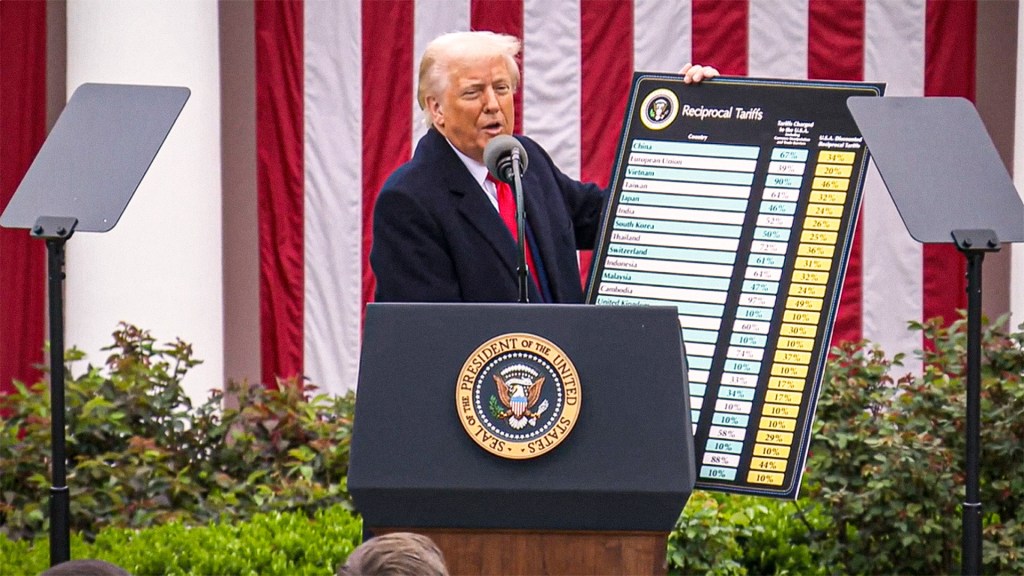
Washington, D.C. – April 2, 2025: In a bold White House Rose Garden address on Wednesday, President Donald Trump proclaimed a “Liberation Day” for American trade policy, unveiling a sweeping plan to impose reciprocal tariffs on foreign imports. The President’s April 2 speech outlined a cornerstone of the Trump economic plan – a strategy he calls “common sense” reciprocal trade policy 2025 – aimed at leveling the playing field by matching other nations’ trade barriers with U.S. import tariffs. As Trump asserted, the days of the United States charging “almost nothing” on imports while trading partners impose steep duties are over. The announcement marks one of the most assertive shifts in U.S. trade stance in decades, underscoring Trump’s campaign promise to put “America First” in global commerce.

Key Highlights:
- “Liberation Day” Trade Overhaul: President Trump’s April 2 Rose Garden speech declares a new era of reciprocal trade policy 2025, tying U.S. import tariffs to the rates foreign nations charge on American goods.
- Reciprocal Tariffs on Key Partners: New Trump Liberation Day tariffs will mirror about half of foreign tariffs – e.g. China at 34% (vs. China’s ~67% on U.S. exports) – targeting countries like China, India, Japan, Vietnam, and the EU.
- “Build in America” Incentive: Trump tells companies if they want zero tariffs, they must “build your product right here in America,” emphasizing a push to onshore manufacturing.
- Patriotic Tone, Bold Claims: Calling the policy “common sense” and “kind reciprocal,” Trump vows the tariffs will protect U.S. industries and spur economic growth “like you haven’t seen before,” fulfilling a major campaign promise.
- Global Challenge: The President challenges allies and rivals alike to drop their own trade barriers and “don’t manipulate your currencies,” signaling tough negotiations ahead as trading partners grapple with the new U.S. stance.
A ‘Liberation Day’ for American Trade Policy
Standing before charts of global tariffs and backed by American manufacturers, President Trump cast the announcement as a historic turning point for U.S. trade. He dubbed April 2 “Liberation Day,” framing it as the moment the United States frees itself from unfair trade practices that he says have long disadvantaged American workers and factories. “We never charge anybody anything, but now we’re going to charge,” Trump declared, referring to past U.S. policy of minimal tariffs.
Trump’s tone was assertive and unapologetically patriotic. He argued that for years other countries have “ripped us off” with high tariffs and restrictive trade barriers while enjoying near-free access to the U.S. market. “It’s so sad to say. It’s so pathetic,” he said about previous U.S. leaders allowing this imbalance. The President’s supporters have likened this move to an economic independence day – a bold reclaiming of America’s right to reciprocal trade fairness.
In his speech, Trump explicitly linked this initiative to his 2024 campaign promises. “I campaigned on this policy throughout last year, and today that promise was kept – promises made, promises kept,” he proclaimed. By casting the tariff plan as a kept promise, Trump not only energizes his political base but also sends a message globally that he is serious about reshaping trade relationships immediately in his new term.
Reciprocal Trade Policy 2025: Tariff Breakdown by Country
At the heart of the announcement is a simple concept: reciprocal tariffs. For decades, many countries have levied high duties on American exports while the U.S. charged little to nothing on imports. Trump’s reciprocal trade policy 2025 seeks to level the playing field by imposing tariffs on imports roughly half of what each country charges the U.S. – a measure the President called “kind reciprocal” (since it stops at 50% rather than matching 100% tit-for-tat). “In other words, they charge us, we charge them. We charge them less. So how can anybody be upset?” Trump said, characterizing the approach as more than fair
Below is a breakdown of the announced Trump tariffs on key trading partners, compared to the rates those nations impose on U.S. goods:
- China: 34% U.S. tariff on Chinese imports (versus China’s estimated 67%)
- European Union: 20% U.S. tariff (vs. 39%)
- Vietnam: 46% U.S. tariff (vs. 90%)
- Taiwan: 32% U.S. tariff (vs. 64%)
- Japan: 24% U.S. tariff (vs. 46%)
- Cambodia: 40% U.S. tariff (vs. 97%)
- South Africa: 30% U.S. tariff (vs. 60%)
- United Kingdom: 10% U.S. tariff (vs. 10%)
By only charging roughly half of what other countries do, Trump framed the move as measured rather than punitive. “This is not full reciprocal. This is kind reciprocal,” he explained, emphasizing that the U.S. could justify even higher tariffs but is choosing restraint for now. “If they complain… my answer is very simple: If you want your tariff rate to be zero, then build your product right here in America because there is no tariff,” Trump said pointedly.
“Build in America”: Tariffs as an Economic Catalyst
A major theme of the Trump April 2 speech was using tariffs as leverage to boost domestic manufacturing. “If you want your tariff rate to be zero, then build your product right here in America,” Trump urged companies, explicitly tying the tariff policy to his “Build in America” mantra. He noted that many firms are already responding: “We’ve seen companies coming in like we’ve never seen before,” he said.
Trump cited the example of a major semiconductor factory project by a Taiwanese company in the United States. Such investments are exactly what the administration hopes to encourage. By imposing tariffs on imports, Trump aims to make it less attractive to produce goods overseas for the U.S. market, and more attractive to produce within the United States. “Tariffs give our country protection against those that would do us economic harm… but even more importantly, they will give us growth,” Trump argued. He proclaimed the coming growth will be “like you haven’t seen before” under this plan.
The President’s tone brimmed with economic nationalism. He portrayed the tariff plan as common-sense patriotism – protecting American workers and industries from predatory foreign practices. By using the Rose Garden (often a venue for significant policy announcements), Trump underscored the importance of this initiative to his overall economic agenda. It’s not just a trade policy, but a linchpin of what supporters call the Trump economic plan to restore American industrial might, increase jobs, and strengthen national security by reducing reliance on foreign supply chains.
Global Reactions and Next Steps
Trump’s reciprocal trade policy 2025 is poised to shake up relationships with allies and competitors alike. In his speech, the President anticipated pushback from foreign capitals and multinational companies – and issued a blunt challenge to them. To U.S. trading partners, he delivered a clear message: “Terminate your own tariffs, drop your barriers, don’t manipulate your currencies” if you expect relief from the new U.S. tariffs. He accused many countries of currency manipulation “like nobody can even believe” as a means of disadvantaging the U.S., calling it a “bad, bad thing” that hurts American industries. The implication is that nations like China, which have been criticized for weakening their currency to boost exports, must also play fair if they want improved relations.
Allies who have enjoyed tariff-free access to the U.S. or special trade deals may also face tough talks. Trump indicated everyone will be calling to ask for exemptions, but reiterated that the only path to exemption is for those countries to open their own markets and treat American exports fairly. This hardline stance suggests that traditional diplomatic pleas or status quo arguments won’t easily sway this White House. Instead, trading partners might need to negotiate new bilateral agreements or mutual tariff reductions to avoid the reciprocal levies.
As this reciprocal trade policy rolls out, the world is bracing for a new chapter of trade relations with the United States. Many details – such as the exact timeline for tariff imposition and whether Congress or additional executive actions are needed – remain to be seen. For now, Trump has set the tone with his Rose Garden declaration. The “Liberation Day” speech sends an unmistakable signal: under President Trump’s leadership, the U.S. will no longer hesitate to wield tariffs in pursuit of what he sees as reciprocal trade justice.
With an assertive, patriotic flourish, Trump closed his address looking toward the future. “These tariffs are going to give us growth like you haven’t seen before… It will be something very special to watch,” he vowed. As the sun set on “Liberation Day,” supporters cheered the fulfillment of a key Trump promise, while businesses and foreign governments recalculated their next moves in the face of America’s newly declared economic independence.


 The Founding Press
Leave a comment