
By the Editors, Founding Press – April 2, 2025
Introduction: A Third Term for Trump?
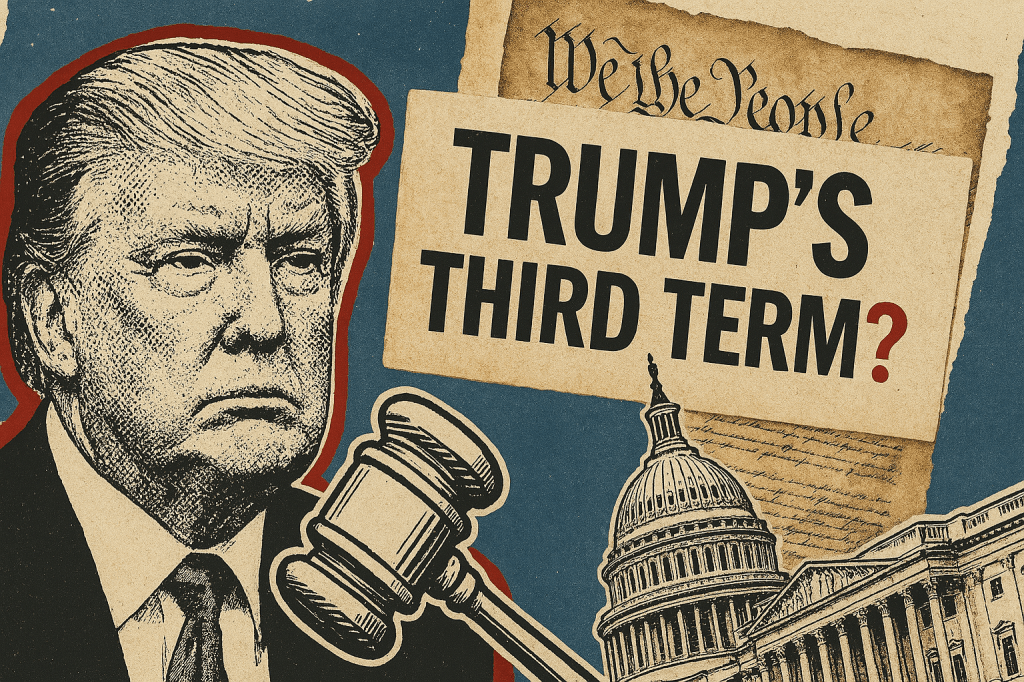
Is the idea of Donald Trump serving a third term in the Oval Office pure fantasy, or is there any legal path to make it a reality? Since regaining the White House in 2024, President Trump has dropped humorous hints – and some not-so-humorous ones – about sticking around past the usual eight-year limit. “I suspect I won’t be running again, unless you do something,” Trump quipped to House Republicans shortly after the election, teasing that they might just have to “figure it out” if he’s so good at the job . More recently, he even insisted “I’m not joking” about pursuing a third term, suggesting “there are methods” to pull it off . These remarks have set tongues wagging in Washington and beyond. Could the Constitution – that old parchment the former President often praises – actually allow such a thing?
In this in-depth analysis, we’ll examine the constitutional guardrails (namely, the 22nd Amendment), the historical context of presidential term limits, and any potential loopholes or grey areas that Trump’s allies might seize upon. We’ll revisit precedents like Grover Cleveland’s non-consecutive presidencies, speculate about the current movement among Trump loyalists to enable an extra term, and weigh whether amending the Constitution (again) is even remotely plausible. Along the way, we’ll address common misconceptions – all with a slightly satirical wink and a nod to the Founders’ intentions. Buckle up: the road to a third term is a winding one, full of constitutional twists and political turns.
The Two-Term Tradition and the 22nd Amendment

When pondering a third term for any president, the towering obstacle is the 22nd Amendment to the U.S. Constitution. Adopted in 1951, this amendment was a direct response to Franklin D. Roosevelt’s unprecedented four election victories (1932, 1936, 1940, 1944). FDR’s lengthy tenure shattered the informal tradition set by George Washington – a two-term tradition that every president until FDR had respected, with the notable exception of some earlier flirtations discussed later . Alarmed by the prospect of a leader serving virtually for life, the nation moved to codify term limits.
What exactly does the 22nd Amendment say? In simple terms, it declares that no person can be elected President more than twice. It also stipulates that if someone assumes the presidency for more than two years of another president’s term (say, a vice president finishing out a term after a death or resignation), that counts as one of the two allowed elections . In short, two victories at the ballot box is the max. As the amendment’s text states: “No person shall be elected to the office of the President more than twice…” . The intent was clear – to prevent another FDR-style prolonged presidency and ensure regular turnover in the nation’s highest office.
Notably, the amendment does not say “no person shall serve more than two terms,” but rather “be elected more than twice.” That wording has prompted some creative legal interpretations (more on those in a moment), but the straightforward reading is that winning a third presidential election is forbidden, period . After its ratification, no president has seriously attempted to defy this limit. Even popular two-termers like Ronald Reagan and Barack Obama packed their bags after eight years, despite supporters wistfully imagining otherwise. In fact, Reagan shortly before leaving office mused that he “would push for a repeal” of the 22nd Amendment, calling it an infringement on the people’s right to re-elect whom they want . Democrat Harry Truman (who was exempt from the new amendment and briefly considered running again) bluntly called the two-term limit “stupid” . And Bill Clinton, late in his second term, half-joked that he would have won a third election if allowed – a claim not without basis, given his high approval at the time . But talk is talk; none of these men tested the constitutional boundaries in practice.
Donald Trump, however, has never been shy about bulldozing norms, and he’s unique in one important way: his presidency has not been consecutive. Trump served from 2017–2021, lost the 2020 election, and then came roaring back in 2024. This makes him only the second U.S. president in history to serve non-consecutive terms, the first being Grover Cleveland in the late 19th century . Cleveland was the 22nd and 24th president (1885–1889 and 1893–1897), with a four-year gap in between. Back then, there was no 22nd Amendment, so the only thing stopping Cleveland from trying again in 1896 or 1900 was political will (in fact, some Democrats did tout him in 1896, but he did not actively run). The two-term tradition held sway but was not legally binding. It took FDR’s four terms to finally spur the formal amendment.
In Trump’s case, the non-consecutive nature of his terms raises an eyebrow for some supporters: since his two terms weren’t back-to-back, is a “third” term really prohibited? The answer is yes – absolutely. The 22nd Amendment’s limit of two elections makes no distinction between consecutive or not. Trump has now been elected president twice (2016 and 2024), which, under the Constitution, is the cap . Non-consecutiveness might make it feel less like he’s “hogging” the office, but legally it’s irrelevant. As one legal scholar wryly put it, “No person shall be elected more than twice” is about as clear as it gets . So if the President truly intends to stick around after January 20, 2029, he’ll need to find a way around that very clear prohibition.
Loopholes, Gray Areas, and “One Weird Trick” Schemes
Leave it to lawyers and determined politicians to hunt for loopholes. The phrasing of the 22nd Amendment – focusing on being elected – has tantalized some with the notion that a former two-term president might serve again without technically being elected to the office a third time. How would that work? The most commonly floated scenario is the “Vice President gambit.” In theory, a term-limited president could run as vice president on someone else’s ticket, win the election as #2, and then succeed to the presidency if the #1 stepped aside or was unable to serve. After all, the person would not have been elected president that year, only vice president – so, loophole achieved, right?
Not so fast. This idea gained attention back around 2000 when some wondered if Bill Clinton could return to the White House as Al Gore’s VP. Even a respected constitutional scholar, Professor Michael Dorf, wrote at the time that the Constitution “permits a Gore–Clinton ticket,” arguing that the 22nd Amendment doesn’t explicitly make two-termers ineligible to serve, only to be elected . In 2006, law scholars Scott Gant and Bruce Peabody made a similar case in the Christian Science Monitor, playfully titled “How to bring back Bill,” asserting a Clinton-Clinton ticket was “constitutionally possible.” . These arguments lean on a hyper-literal reading of the text. They concede it would flout the spirit of the amendment, but maintain it might slip through the letter of the law.
However, most experts pour cold water on this gambit. The counter-argument cites the 12th Amendment (ratified 1804), which states that “no person constitutionally ineligible to the office of President shall be eligible to that of Vice-President.” If a two-term ex-president is deemed “constitutionally ineligible” to be president again (thanks to the 22nd Amendment), then by the 12th Amendment that person cannot be VP either . Advocates of the loophole theory respond that the ex-president isn’t ineligible to hold office – only barred from being elected to it. It’s a fine distinction that has never been tested in court, because no one has been bold (or foolish) enough to attempt it. But according to Prof. Derek Muller, an election law expert at Notre Dame, “if Trump is not eligible to run for president again because of the 22nd Amendment, he is not eligible to run for vice president, either.” In short, “there’s no ‘one weird trick’ to get around presidential term limits,” Muller says . That reflects the consensus view. Any attempt to sneak in through the VP backdoor would almost certainly trigger legal challenges and be struck down as unconstitutional sleight-of-hand.
What about other creative maneuvers? One extreme idea floated in some corners of the internet: Trump could angle to become Speaker of the House (a position technically not required to be held by a member of Congress) and place himself in the line of succession. Then, if the presidency were vacated, the Speaker assumes the office. Theoretically, President Trump could resign on January 19, 2029, have Vice President J.D. Vance become President for a day, and appoint Trump as Speaker; then Vance resigns, making Speaker Trump president again. Sounds like a political thriller plot – and it is, in the worst way. Such a convoluted scheme would break so many norms (and likely laws) that it’s hard to imagine it getting off the ground. As one commentator noted, it would require “extraordinary acquiescence by federal and state officials, not to mention the courts and voters themselves,” meaning everyone would have to play along with the subterfuge . Realistically, the intricate house of cards would collapse under legal scrutiny and public outcry long before reaching fruition.
In essence, the loopholes are more theoretical than practical. No court has ever had to directly interpret the 22nd Amendment’s fine print because no one has come close to violating it. If Trump or his allies tried some unprecedented end-run, it’s a safe bet the Supreme Court (including Trump’s own appointees, who purport to be faithful to the Constitution’s text) would slam the door. “There are no credible legal arguments for him to run for a third term,” says Jeremy Paul, constitutional law professor at Northeastern University . The framers of the 22nd Amendment may not have explicitly forbade serving a third term via succession, but their intent was clearly to prevent any individual from holding the presidency too long. A judge looking at a dubious scheme would likely say, “Nice try, but no.” In other words, Trump’s best shot at a third term isn’t a legal hack or magic loophole – it would have to be through changing the Constitution itself.
The Constitutional Amendment Option: Changing the Rules of the Game
If you can’t fit through a loophole, you might try blowing a hole in the wall. The only ironclad way to let a president serve more than two terms is to amend the Constitution to repeal or modify the 22nd Amendment. This is exactly what some of Trump’s staunchest allies have begun advocating. In January 2025, mere days after the new Congress convened, Republican Representative Andy Ogles introduced a joint resolution proposing to do just that. Ogles’ resolution would allow a president to serve a third term “provided that their first two are non-consecutive.” The intent was transparently aimed at one man: the text was crafted specifically to make incumbent President Trump eligible for another go, since he’s currently the only living person who fits the non-consecutive criterion . (In case anyone thought this was about principle and not person, note that this wording conveniently excludes former President Obama or George W. Bush from staging a comeback. One imagines that was no accident.)
The Ogles proposal set off a flurry of headlines and a fair bit of eye-rolling. MSNBC dryly noted the bill “would let Trump (but not Obama) run for a third term.” Meanwhile, a CNBC report outlined the plan and just how steep a hill it faces . To actually amend the Constitution, two things must happen: (1) Congress must approve the amendment by a two-thirds supermajority in both the House and Senate, and (2) three-fourths of state legislatures (that’s 38 states) must ratify it. This is an exceedingly high bar – by design. The Founders didn’t want the Constitution rewritten on a whim or at the behest of fleeting majorities.
Historically, attempts to repeal or modify the 22nd Amendment have gone nowhere. Starting just five years after it was ratified, members of Congress periodically introduced bills to scrap the two-term limit . Over 50 such joint resolutions were floated from 1956 through the early 2000s . Every single one failed to gain traction. Democratic Congressman José E. Serrano became famous (or notorious) for introducing a repeal resolution in nine consecutive Congresses from 1997 onward . It didn’t matter whether Democrats or Republicans controlled Congress – there was never a serious appetite to reopen the Pandora’s box of unlimited presidential tenure.
Even with Trump’s hold on the GOP base, the prospects for Ogles’ “Trump Third Term Amendment” are, to put it mildly, slim. For one, it’s not clear Ogles can even get a simple majority of his fellow House Republicans on board, let alone two-thirds of both chambers. When Trump joked to House members about needing a third term, many laughed it off. One Trump ally, Rep. Troy Nehls of Texas, literally told reporters, “Are you kidding me? Just stop it.” when asked if he’d support such an effort . It’s one thing to cheer Trump at rallies; it’s another to sign your name to a constitutional overhaul explicitly for his benefit. GOP leadership has so far been non-committal or silent – Speaker Mike Johnson hasn’t touched the issue with a ten-foot pole, and when the AP reached out for comment to Republican leaders, they politely had nothing to say .
But even if by some miracle 290 House members and 67 Senators voted for this amendment, the state legislatures pose an even bigger hurdle. Do we really expect 38 states to agree on extending Donald Trump’s presidency? The country is fiercely divided; Democrats control many state legislatures that would rather gnaw off their own arm than hand Trump a third term. And even in some red states, the idea might not be universally popular – remember, the two-term limit has broad public support as a check on executive power, regardless of party. It protected America from hypothetical endless reigns of not just FDR, but also beloved figures like Reagan or Obama. Many Americans instinctively recoil at the notion of a president-for-life scenario, having been raised on tales of George Washington stepping down voluntarily to ensure we’re not a monarchy.
As Harvard law professor Laurence Tribe put it (regarding a previous third-term chatter), amending the Constitution in this way would be “impossibly difficult” under current political conditions . The last successful amendment, the 27th (on congressional pay raises), took 202 years to be ratified after proposal! By contrast, here we’d be trying to rush through an amendment in a year or two, in a bitterly polarized climate, all for the benefit of one polarizing individual. Unless Trump suddenly achieves stratospheric bipartisan popularity (in an alternate universe perhaps), a constitutional amendment enabling his third term is a pipe dream.
Allies, Opponents, and the Political Climate
Despite the legal barriers, the idea of a third term for Trump has ardent fans and equally ardent foes, underscoring how political this constitutional question really is. Among Trump’s inner circle and base, there’s an almost romantic notion that he deserves extra time in office. Why? For some, it’s because they believe his 2020 defeat was illegitimate – a claim repeatedly debunked, yet fervently held by many in Trumpworld. Trump himself feeds this narrative: he told reporters that seeking a third term is effectively righting a wrong, since “the other election, the 2020 election, was totally rigged.” (For the record, it was not; Joe Biden won fair and square, but Trump’s belief in his own victimhood is unwavering.) . By Trump’s logic, 2025–2029 is only his second term “in a way,” the 2021–2025 term having been “stolen” from him. Thus, a run in 2028 would be just claiming the real third term he was denied. This narrative, while false in fact, provides a psychological rallying cry to his supporters: give the man the time we owe him.
At the recent Conservative Political Action Conference (CPAC), Trump’s former strategist Steve Bannon fired up the crowd with exactly this sentiment. “We want Trump in ’28!” Bannon thundered to cheers . The very notion that CPAC – a conference once known for Reagan worship and small-government principles – is now essentially chanting for a potential President-for-12-Years would have been unthinkable a decade ago. Yet here we are. Bannon’s argument (and that of many grassroots supporters) is straightforward: they love Trump, they think he’s saving America, so why limit him? If two terms are good, three might be better. One 30-year-old attendee at a Trump rally in Wisconsin captured this mood, saying she would “absolutely” support Trump serving longer because “America needs him… we’re headed in the right direction and, if he doesn’t do it, we’re probably headed backwards.” . In these circles, objections about the Constitution or democratic norms often fall on deaf ears – or are dismissed as technicalities that clever people will sort out. After all, Trump has made a career of defying the experts.
On the other side of the aisle (and among many independents), talk of a third term is met with a mix of alarm and outrage. Critics see it as confirmation of their worst fears about Trump’s authoritarian impulses. Back in the 2024 campaign, opponents warned that Trump would try to shred constitutional limits if returned to power – now his own words are adding fuel to that fire. Representative Daniel Goldman (D-NY), who served as counsel in Trump’s first impeachment, released a statement after Trump’s “I’m not joking” comments, accusing him of a “clear effort to take over the government and dismantle our democracy” . Goldman challenged Congressional Republicans to “go on the record” opposing any third-term ambitions if they truly respect the Constitution . Thus far, few Republicans have done so explicitly, preferring to treat Trump’s comments as offhand joking – which, in fairness, some of them likely are. Trump has long enjoyed trolling his opponents with outrageous asides (during his first term he joked that maybe “we’ll give [him] an extra two years” to make up for the Mueller investigation, sending liberal pundits into a tizzy).
This dynamic – Trump flirting with norm-busting, his base cheering, his opponents screaming – has a somewhat performative aspect. Why does Trump keep dangling the idea of a third term at all? Some observers believe it’s largely about power right now. A second-term president is normally a lame duck from day one, since everyone knows he’s out in four years. By suggesting he might not be done, Trump maintains an aura of political strength. “A lame-duck president like Donald Trump has every incentive in the world to make it seem like he’s not a lame duck,” notes Derek Muller . Indeed, by keeping Republicans (and Democrats) guessing about his true intentions, Trump preserves leverage. Republican lawmakers might think twice about crossing a president who could theoretically be around beyond 2029 – stranger things have happened in history, after all. It’s a way of extending his relevance and influence.
Trump also relishes how it agitates the media and his critics. He has insisted with a grin that his third-term talk really is a joke – at least sometimes. “That was a joke… he jokes all the time,” defended Rep. Eli Crane (R-AZ) when reporters pressed the issue . Even Trump’s “I’m not joking” line came with a wink; when NBC’s Kristen Welker pressed him on one possible method (having VP Vance run and then hand off power), Trump chuckled, “Well, that’s one… there are others,” but coyly refused to detail any, saying “No” when asked for specifics . This is classic Trumpian ambiguity – keeping things unclear enough to stoke intrigue, but not committing to any plan that could backfire immediately.
Meanwhile, Americans at large seem to have mixed feelings. They may cheer for their favorite president to stick around (Democrats in 2016 sometimes mused about a third Obama term, just as Republicans did for Reagan in 1988), but there remains a deep cultural aversion to anything resembling an indefinite presidency. The Founding Fathers themselves hotly debated term limits. Alexander Hamilton actually argued for lifetime tenure (believing stability was paramount), but others like George Mason decried that as tantamount to an elective monarchy . The compromise at the Constitutional Convention was a four-year term with no explicit limit, trusting in Washington’s voluntary two-term example to set precedent . For 150 years that held, until FDR’s era showed that perhaps not everyone would willingly follow Washington. The 22nd Amendment was the bipartisan answer – passed by a Republican-led Congress but also ratified by states of both parties. Even the public sentiment in 1951 favored ensuring no one person could hold too much power for too long.
Today, polling on the 22nd Amendment consistently finds a majority of Americans favor the two-term limit. Any proposal to change it usually lacks broad public support – unless perhaps phrased as “allow the people to choose their president without restriction,” in which case a chunk of voters say in principle it sounds democratic to let a popular president run again. But when you substitute a name (e.g., “Should Donald Trump be allowed to serve a third term?” or the same for Obama), opinions break sharply down party lines. Given that stark divide, it’s hard to imagine a groundswell of popular demand for a Trump third term that extends beyond his base. In fact, Trump faces the hurdle that while his base is intensely loyal, he has historically struggled to win over a majority of Americans in elections. Betting on a constitutional amendment or controversial legal theory to keep him in power might be far less effective than simply trying to govern in a way that enlarges his coalition (or so one might advise the President, if he were inclined to listen).
To Trump’s credit (or perhaps to sate his ego), he often notes that he doesn’t need a third term. He’s boasted that he will accomplish more in 8 years than others could in 12. In response to accusations that he wants to be a dictator, Trump jokingly promised that he’d only be a “dictator” for one day – just long enough to “close the border and drill, baby, drill” – after which, he claims, he’d happily return to normal order . Such remarks blur the line between jest and intent, leaving Americans alternately amused or uneasy.
Common Misconceptions About a Third Term
Let’s address a few common misconceptions that frequently arise in discussions about a hypothetical Trump third term:
• “The 22nd Amendment only prevents consecutive third terms, so non-consecutive should be fine.”
Reality: False. The amendment doesn’t distinguish between consecutive or not – it’s a lifetime two-election limit. Grover Cleveland’s non-consecutive presidencies occurred before the amendment existed. Today, any two successful elections exhaust a person’s eligibility . Trump 2016 + Trump 2024 = two. That’s all the Constitution allows, consecutive or otherwise.
• “If a term was ‘stolen’ or cut short, a president can get an extra term.”
Reality: There is no provision in the Constitution to grant a “do-over” term because you feel one was unfairly taken. Trump’s assertion that 2020 was rigged does not change the constitutional math (and every credible investigation confirmed the election’s legitimacy). Unless an election result were legally overturned (which 2020’s was not and will not be), the term counts. Personal grievance doesn’t equate to a constitutional exception.
• “A former two-term president could just become Vice President or Speaker and slide into the presidency legally.”
Reality: Highly doubtful. The 12th Amendment bars anyone ineligible for the presidency from holding the vice presidency . While some argue a loophole exists if not elected directly to president, most scholars agree this wouldn’t fly in court. As for the Speaker idea, the Presidential Succession Act has never been tested in such a bizarre way, but it’s implausible that this end-run would be deemed constitutional (not to mention politically insane). No “silver bullet” loophole has convinced the legal community at large .
• “If people really wanted it, we could just repeal the two-term limit easily.”
Reality: Amending the Constitution is deliberately very hard. It hasn’t been done since 1992. In the past 70+ years, dozens of attempts to repeal or relax the 22nd Amendment have failed . There is currently not a broad bipartisan movement to change this. At best, a subset of one party’s lawmakers support it (for one specific person), which is a far cry from the supermajorities needed. Public opinion would have to shift dramatically, and many institutional hurdles overcome, before a third term amendment stood a chance.
• “Maybe the Supreme Court can just reinterpret the 22nd Amendment or declare it doesn’t apply.”
Reality: The Supreme Court cannot simply ignore a crystal-clear constitutional limit. The 22nd Amendment’s text is unambiguous. There’s no serious legal theory under which the Court could say “actually, this doesn’t mean what it says.” The Court’s role would likely come only if some trick like the VP scheme was tried – and in that case, the Court would enforce the amendment, not nullify it. The justices might differ on many things, but it’s hard to imagine even the most pro-Trump among them contorting the plain language here. As one federal judge quipped (hypothetically), “We have a 22nd Amendment. It means what it says.” End of story.
Conclusion: Law vs. Ambition
In the final analysis, Donald Trump serving a third term remains a constitutional longshot – a provocative idea that makes for headline fodder and rally applause, but one that collides with the bedrock of U.S. law. The 22nd Amendment was specifically designed to prevent what Trump now teases he might do. Short of a successful constitutional amendment (which is about as likely as turning Mar-a-Lago into Mount Vernon), any attempt to keep Trump in power past January 2029 would face insurmountable legal challenges and, one hopes, bipartisan resistance in the name of the rule of law.
That said, we can allow ourselves a mildly satirical aside: one can picture Trump musing in the mirror, “third time’s the charm,” perhaps envisioning Mount Rushmore with a fifth face. His detractors fear a budding tyrant, while his admirers see a hero beset by unfair rules. In truth, American democracy, through its Constitution, has a pretty effective built-in defense against any single person clinging to power indefinitely – even one as persistent as Donald J. Trump. The Framers (and later reformers in 1951) set up the presidency to be a temporary trust, not a personal fiefdom. And despite all the “wink and nod” suggestions that Trump might test that, he has not crossed the Rubicon just yet.
Could that change? Perhaps if the political stars align in some unforeseeable way, Trump’s camp might actually push the amendment effort further, or try an unorthodox maneuver. But as of now, it’s mostly smoke, not fire. Trump himself acknowledged in one breath that he doesn’t want to talk about a third term “because no matter how you look at it, we’ve got a long time to go” – tacitly admitting this is a distant speculation. In the meantime, floating the idea serves his immediate interests: keeping his supporters energized and his opponents enraged. It’s the art of having it both ways – enjoying the perks of hinting at extra-legal power, without actually breaking the law.
For Americans who care about the Constitution (and that should be all of us, Founding Press readership especially!), this episode is a reminder of the importance of our institutions. Term limits may frustrate fans of a popular leader, but they protect the republic from the very real perils of concentrated power. Today it might be your preferred president you wish could stay longer; tomorrow it could be someone you despise. The rules must apply evenly. Even Ronald Reagan, for all his opposition to the 22nd Amendment, ceded that eight years was enough – joking that he’d like to endorse the repeal “so it would be on the books in time for President Hillary Clinton” (a quip he made in 1989). In the end, the wisdom of the Founders and their successors has been to err on the side of rotation in office.
So, could Trump legally serve a third term? Almost certainly not, barring a constitutional miracle. The 22nd Amendment stands as an immovable object against the irresistible force of Trump’s ambition. And if history is any guide, that amendment isn’t going anywhere. Grover Cleveland earned his trivia-question place in history with two non-consecutive terms; Donald Trump will likely have to be content matching that feat and no more. Anything beyond that will remain, as of now, the stuff of tavern talk, Twitter trolls, and speculative op-eds – a political fantasy that runs up against a very real constitutional brick wall.
In America, nobody is above the law – not even a former (and current) president with an ardent following. The peaceful transfer of power, at regular intervals, is a hallmark of the republic. If President Trump truly wants to cement his legacy as a defender of our founding principles (as his supporters often claim), respecting the two-term limit might be the ultimate test. Otherwise, he can try to go down in history as the man who fought the 22nd Amendment…and lost. Either way, the saga makes for sharp commentary and serious contemplation about the durability of U.S. constitutional norms. And that is no joke.
Sources:
• U.S. Constitution, Amendment XXII – Presidential term limits
• National Constitution Center – “Twenty-Second Amendment” (Buckley & Metzger)
• Associated Press – “Trump says he’s considering ways to serve a third term” (March 2025)
• The Hill – “Trump floats seeking third term in joke to House GOP” (Emily Brooks, Nov 13, 2024)
• CNBC – “Constitutional amendment to allow Trump third term introduced in House” (Jan 2025)
• MSNBC – “New GOP bill would let Trump (but not Obama) run for a third term” (Steve Benen, Jan 2025)
• U.S. National Archives – Records on the 22nd Amendment & term limit debates
• Minnesota Law Review (Peabody & Gant, 1999) – “The Twice and Future President: Constitutional Interstices and the 22nd Amendment”
• CNN (Dorf, 2000) – “Why the Constitution permits a Gore–Clinton ticket”
• Christian Science Monitor (Gant & Peabody, 2006) – “How to bring back Bill (Clinton-Clinton 2008 ticket)”
• NPR – “Trump is hoping to win non-consecutive terms. Only one president has done it” (Rachel Treisman, Nov 4, 2024)
• Presidential statements and interviews (NBC News interview with Trump, Dec 2023; Rolling Stone interview with Bill Clinton, 2000)
(All quotations and facts are sourced as indicated above. Legal interpretations are attributed to constitutional scholars and contemporary news analyses for accuracy.)


 The Founding Press
Leave a comment